











Article: Natural vs Color-Enhanced Black Diamonds: What the Certificate Tells You
Natural vs Color-Enhanced Black Diamonds: What the Certificate Tells You
Most black diamonds sold in jewelry today are color enhanced: they are natural, earth-mined diamonds whose black color was deepened or created after mining, usually with heat. A natural-color black diamond gets its color in the ground, from dense mineral inclusions, and is rarer. Both are diamonds; what separates them is where the black came from, and a good certificate or lab report says which one you are holding. Every black diamond we set is natural, earth-mined and color enhanced, and the certificate that comes with the piece states it.
The word "treated" lands hard when you have already fallen for a stone. A buyer on a gemstone forum put it simply: treated black diamonds look really pretty, so should she only buy a natural, untreated one, or skip diamonds altogether? The replies split, and some were sure that a uniform, jet-black untreated diamond barely exists. This page is the calm version of that thread: what each word on the paperwork means, what changes with treatment and what does not, and the questions worth asking before you buy.
Natural vs color-enhanced black diamonds: the short comparison
| Natural-color black diamond | Color-enhanced black diamond (heat) | Irradiated diamond | Coated diamond | |
|---|---|---|---|---|
| Where the black comes from | Dense natural inclusions such as graphite, pyrite or hematite | Heat turns the stone's tiny internal fractures into graphite, so it reads black | Irradiation creates a very dark green that looks black | A thin layer of foreign material on the surface |
| Is it a natural, earth-mined diamond? | Yes | Yes | Yes, if the starting stone was mined | The diamond underneath may be |
| Is the color permanent? | Yes | Yes, a stable treatment | Yes, a stable treatment | No, it can wear or be damaged |
| What a lab report says | Color origin: natural | Color origin: treated | Color origin: treated | GIA does not issue reports for coated diamonds |
| Typical look | Opaque, metallic-looking black | Opaque, even black with a mirror-like shine | Very dark green that reads black | Depends on the coating |
| How common in jewelry | Rare | Most black diamonds in jewelry | Less common | Should always be disclosed |

How does a black diamond get its color?
A colorless diamond lets light travel through it. A black diamond stops it. According to the Gemological Institute of America (GIA), most natural-color black diamonds owe their color to huge numbers of fine mineral inclusions, such as graphite, pyrite or hematite, spread through the whole stone. In a natural black, nature did the darkening.
In a color-enhanced stone, a natural diamond that was heavily included and fractured is heated, and the fractures turn to graphite, so the whole stone reads black. GIA's research on black diamonds describes this graphitization in detail. Another route is irradiation, which can give a diamond of poor color a very deep green that looks black. Ours are color enhanced with heat and pressure, as their certificates state.
Are most black diamonds treated?
Yes. GIA states that most black diamonds used in jewelry and engagement rings are treated to create their color. So a jeweler who sells color-enhanced black diamonds and says so is describing the normal market, not hiding a flaw. The red flag is the opposite: a black diamond sold with no word about its color origin, or called "untreated" with no lab report to back it.
Is a color-enhanced black diamond still a natural diamond?
Yes. A color-enhanced black diamond was mined from the earth as a diamond and is still a diamond: crystallized carbon, 10 on the Mohs hardness scale. The treatment changes its color, not what it is. That is the line we draw on every piece. Each black diamond in our natural black diamond rings is a natural, earth-mined diamond, its color is enhanced, and the enhancement is written on its certificate. It is not onyx, spinel or black moissanite, which are different materials (how those four compare).
What does the certificate tell you?
Read three things on any black diamond's paperwork:
- What the stone is. Natural diamond, its shape and carat weight. For a black stone, GIA's colored diamond origin report describes the color as Fancy Black.
- Where the color came from. GIA reports designate a diamond's color as natural or treated, and GIA laser-inscribes the girdle of diamonds it identifies as color treated. Our certificates state "color enhanced".
- Who issued it. A report from an independent gem lab is the strongest proof of a natural color. Telling a natural black from a heat-treated one is hard; GIA's own researchers call it the challenge for gem labs, and it takes laboratory equipment, not a loupe.
Disclosure is also a rule, not a courtesy. In the US, the Federal Trade Commission's Jewelry Guides (16 CFR 23.22) say a seller should disclose a gemstone treatment when it is not permanent, when it creates special care needs, or when it significantly affects the stone's value. Color enhancement of a black diamond affects its value, so it should be disclosed.
Is the color of a color-enhanced black diamond permanent?
A heat-treated black diamond keeps its color: the graphite that makes it black is inside the stone. GIA only issues reports for diamonds with stable treatments, such as irradiation, annealing (heating), laser drilling and HPHT, and it does not issue reports for diamonds with unstable treatments such as coatings or fracture filling. A coating sits on the surface, can wear away or be damaged, and is the one to watch for. If a black stone looks filmy or unevenly dull, ask the seller directly whether it is coated.
Do natural-color black diamonds look better?
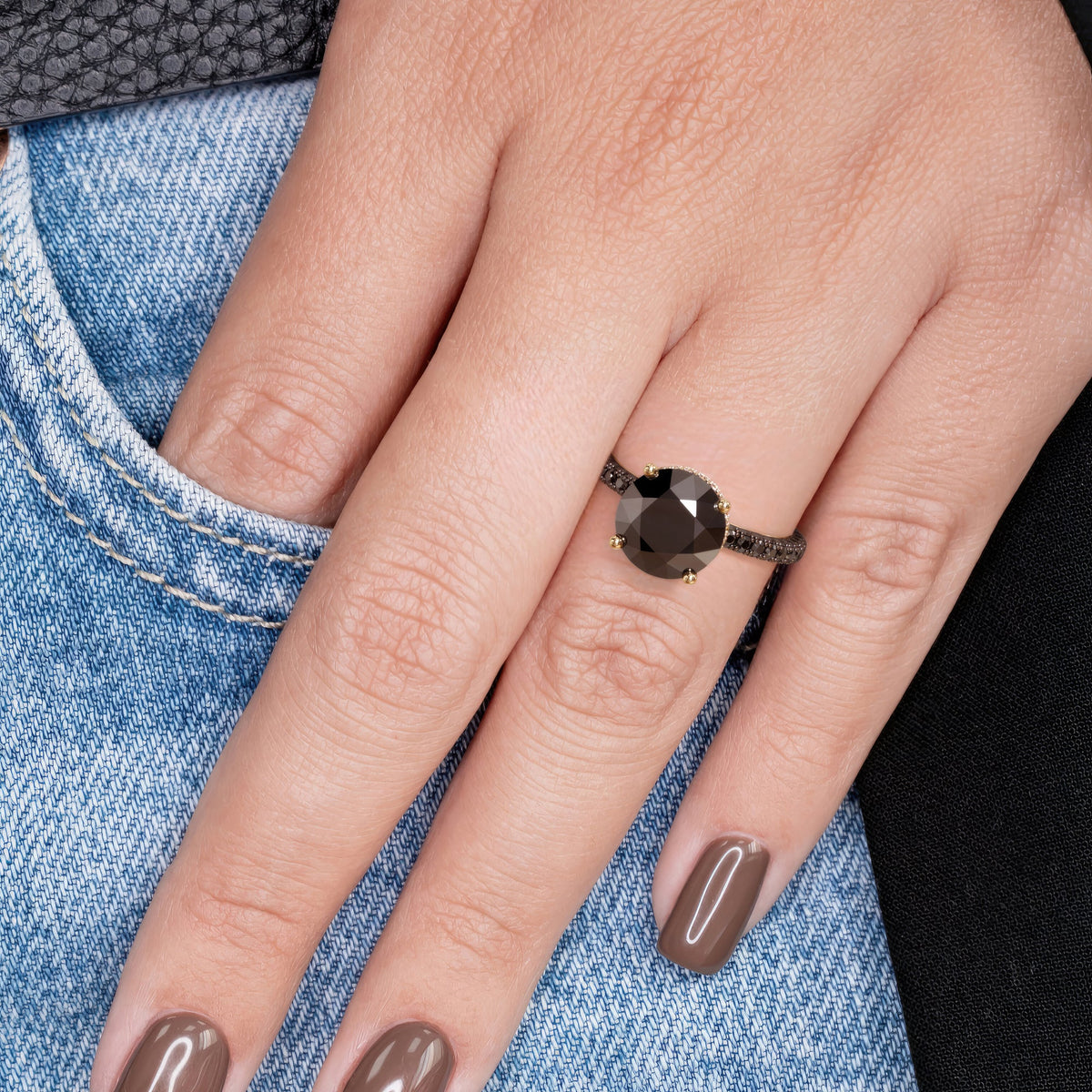
Not necessarily; they differ in origin more than in look. GIA describes natural-color black diamonds as typically opaque with a metallic look, and a well-cut color-enhanced black shows the same opaque, mirror-like shine on the hand. The deep, even black most people picture when they say "black diamond" is, in jewelry, usually an enhanced one. A natural-color black with a lab report is rare, appeals to collectors and usually costs more. For an engagement ring you wear every day, choose the look you love, in a stone whose origin is written down.
Are treated black diamonds worth anything?
They are worth what any diamond of their size, cut and setting is worth on the market: less than a natural-color black of the same size, and much less than a white diamond of the same carat weight. That is the reason many people choose them: a large, dramatic center for a fraction of a white diamond's price (what a black diamond ring costs, by carat). Like most jewelry, a ring resells for far less than it cost new, so buy it to wear, not as an investment. One owner of a 9.8 carat color-enhanced black diamond anniversary ring wrote that strangers rarely notice its size at all. It is a ring chosen for the person wearing it, which is the point.
Is a color-enhanced black diamond more fragile?
A black diamond is as hard as any diamond, so it resists scratches. But GIA notes that a black diamond can hold hundreds or thousands of tiny fractures, which makes it easier to chip than a colorless diamond if it is struck hard. A natural-color black can carry the same risk, because it is full of inclusions too. Three things help:
- A protective setting. Covered points, a bezel or a halo around the stone.
- Take it off for hard work. The gym, moving furniture, gardening.
- Clean it gently. Warm water, mild soap and a soft brush. GIA advises against ultrasonic and steam cleaners for black diamonds.
Our black diamond engagement rings use claw prongs, hidden halos and pavé bands. The Magia Negra set holds a 2.7 carat round black diamond on four prongs over a hidden halo of white diamonds. The Black Magic cushion ring sets a 2.24 carat black cushion over two rows of black and white diamonds.
What to ask before you buy a black diamond
- Is this a natural, earth-mined diamond, or another black stone?
- Is the color natural or enhanced, and how was it enhanced?
- Is that written on the certificate or lab report I will receive?
- Is the stone coated? (The answer should be no.)
- How is the stone protected in this setting, and how should I clean it?
We answer all five on every product page and in person. Every black diamond we set is natural, earth-mined and color enhanced, and the certificate says so. Rings are made to order in 10-14 business days, plus shipping. If you want black and white together, see black and white diamond rings, such as White Night, a 2.6 carat black cushion framed in white diamonds. For a stone with a story, the Kintsugi ring sets a 2.44 carat round black diamond on a band crossed by a black enamel crack. New to black diamonds? Start with our black diamond engagement ring guide.
Natural vs color-enhanced black diamonds: FAQ
Are black diamonds natural or treated?
Both exist. Natural-color black diamonds are rare. GIA states that most black diamonds used in jewelry are treated to create their color, usually with heat. A treated black diamond is still a natural, mined diamond; only its color was changed.
What does "color enhanced" mean on a black diamond?
It means the diamond's black color was created or deepened after mining, usually by heat, which turns its tiny internal fractures into graphite. The stone itself is a natural, earth-mined diamond. Our black diamonds are color enhanced with heat and pressure, and their certificates state it.
Is color enhanced the same as clarity enhanced?
No. Color enhancement changes a diamond's color, as with black diamonds. Clarity enhancement makes a white diamond's inclusions less visible, usually by laser drilling or fracture filling. More in what are clarity enhanced diamonds.
Will the black color fade or wear off?
Not on a heat-treated black diamond: the graphite that makes it black is inside the stone. A coating is different. It sits on the surface and can wear or be damaged, which is why GIA does not issue reports for coated diamonds. Our black diamonds are color enhanced with heat and pressure, as their certificates state.
How can I tell if a black diamond's color is natural?
Only a gem lab can tell reliably. GIA reports designate a diamond's color as natural or treated, and GIA laser-inscribes the girdle of diamonds it identifies as color treated. Looking at the stone, even with a loupe, is not enough.
Are color-enhanced black diamonds worth buying?
If you want the look and the hardness of a diamond, yes. They cost less than natural-color blacks and far less than white diamonds of the same size, and the treatment is permanent. Buy one with a certificate that states the enhancement, in a setting that protects the stone.
Do color-enhanced black diamonds chip more easily?
Black diamonds, natural or treated, often contain many tiny fractures, so GIA notes they can chip more easily than colorless diamonds if struck hard. Choose a protective setting, take the ring off for hard work, and avoid ultrasonic and steam cleaners.
Do your rings come with a certificate?
Yes. Every black diamond we set is a natural, earth-mined diamond, and the certificate that comes with the piece states that its color is enhanced.


Leave a comment
This site is protected by hCaptcha and the hCaptcha Privacy Policy and Terms of Service apply.